How do global verification frameworks impact your caregiving credentials? We analyze the integration of CPD UK points and SDC Canada standards with domestic training programs.
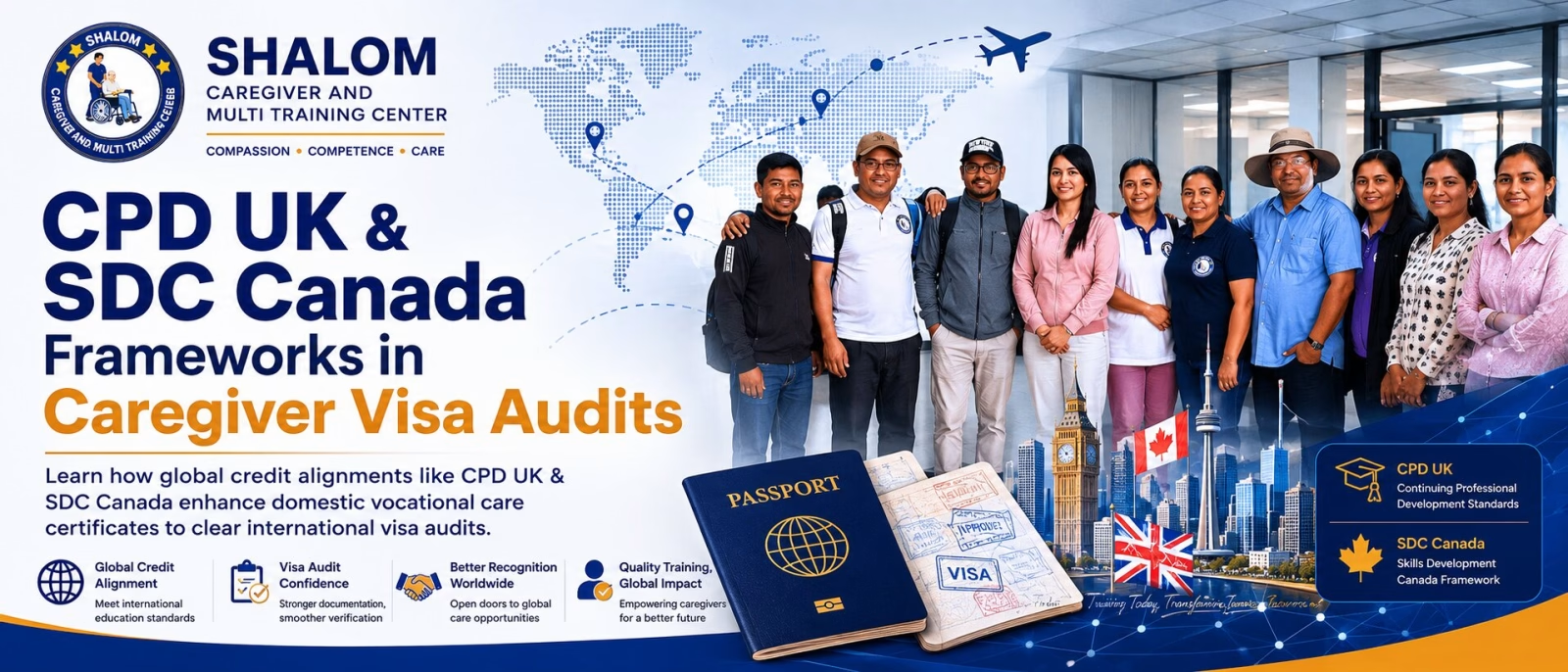
The landscape of vocational healthcare migration has transformed significantly. International health registries, foreign embassies, and healthcare employers no longer accept basic, unverified certificates at face value. For healthcare assistants trained in South Asia, the journey to an overseas care home or hospital requires crossing a rigid barrier of document verification. To bridge this gap, modern institutions must ensure their foundational courses are recognized both nationally and internationally.
While holding a government-backed credential forms the legal baseline, pairing domestic training with globally recognized credit systems provides a distinct advantage. Integrating Continuing Professional Development (CPD) UK frameworks and Skill Development Council (SDC) Canada standards with a local curriculum upgrades a traditional diploma into an internationally recognized credential. Understanding how these global validation structures function is essential for anyone researching the best caregiver training center in nepal.
The Mechanics of CPD UK in Professional Caregiving
Continuing Professional Development (CPD) is a globally recognized framework utilized across the United Kingdom and Europe to track, log, and validate post-academic professional learning. A course carrying official CPD UK accreditation has been audited by independent quality assurance experts to confirm that its educational material, delivery methods, and student assessment paths meet rigid Western workforce metrics.
In healthcare training, CPD points correspond directly to documented instructional contact hours and practical engagement. For example, when a student masters the complex principles of gerontological support or patient hygiene, the CPD portfolio tracks this as a distinct unit of professional growth. This structural documentation ensures that when a National Health Service (NHS) trust or private care provider in the United Kingdom reviews a graduate's file, they see a familiar, verified learning system rather than an unfamiliar domestic certificate.
Understanding SDC Canada and Skill Standardization
On the other side of the Atlantic, the Skill Development Council (SDC) Canada operates on a technology-backed model designed to establish uniform skill standards across the global training community. SDC Canada does not focus on theoretical essays; instead, it evaluates occupational skill sets through structured, proctored assessments and verifiable performance criteria.
When an academy incorporates SDC Canada parameters into its curriculum, it means every practical milestone—from executing safe pivot transfers to standard infection control setups—is measured against Canadian Technical and Vocational Education and Training (TVET) expectations. Candidates are evaluated on their real-world capabilities through digital tracking systems. Upon meeting the required skill levels, they receive a digitally verifiable credential that can be instantly audited by immigration departments or workforce recruiters across North America.
How International Alignments Accelerate Visa Audits
During a visa background check or a professional registry audit, immigration officers look for specific markers of credibility. Unaccredited shortcuts or unmapped training hours often trigger immediate processing delays or visa rejections. Combining European and North American credit systems creates a multi-layered verification framework that streamlines this auditing process.
- Elimination of Manual Background Verification: Standard domestic credentials often require embassies to send slow, manual verification requests back to the country of origin. Globally mapped credentials utilize centralized digital tracking systems, allowing international recruiters to confirm training details instantly online.
- Instant Transcript Compatibility: Foreign nursing boards require explicit proof of your practical laboratory hours. Mapped credits instantly translate your course achievements into recognized international values, proving you possess the clinical competence to work safely from your first day on the job.
- Syllabus Defense During Interviews: When candidates face technical questions during embassy interviews, having trained under verified global frameworks gives them the precise vocabulary and clinical rationale needed to answer confidently and pass their evaluations.
Selecting an Accredited Institution in Kathmandu
Aspiring healthcare workers must look closely at a school's actual accreditation credentials before enrolling. A premium institution should always back its training claims with a transparent, verifiable compliance portfolio. Securing a spot at a center that balances domestic government guidelines with elite international standardizations ensures your financial and professional investment is fully protected.
For students demanding absolute legal security and world-class training quality, navigating to the best caregiver training center in kathmandu is a vital step for their career development. A premier facility should offer high-fidelity medical simulation labs, expert instruction from registered nursing faculty, and a comprehensive curriculum that satisfies local regulations while meeting Western standards. To ensure your credentials survive strict foreign audits, every diploma issued must feature an advanced, secure QR code for instant worldwide digital verification, giving international embassies and global employers immediate access to your verified training records.
Next Steps for Your Professional Career:
- To compare our specialized training programs and review shift structures, visit our comprehensive Main Courses Hub.
- Explore the precise international compliance frameworks integrated into our premier About Us Transparency Portal.
More
Related posts
Training
Oxygen Therapy Management: Non-Invasive Vent Supportive Routines and Flow Rate Controls for Home Caregivers
Read more →
Educational