Osteoarthritis and rheumatoid flare-ups demand highly calculated physical adjustments to prevent joint fusion. We break down passive range-of-motion rules and ergonomics.
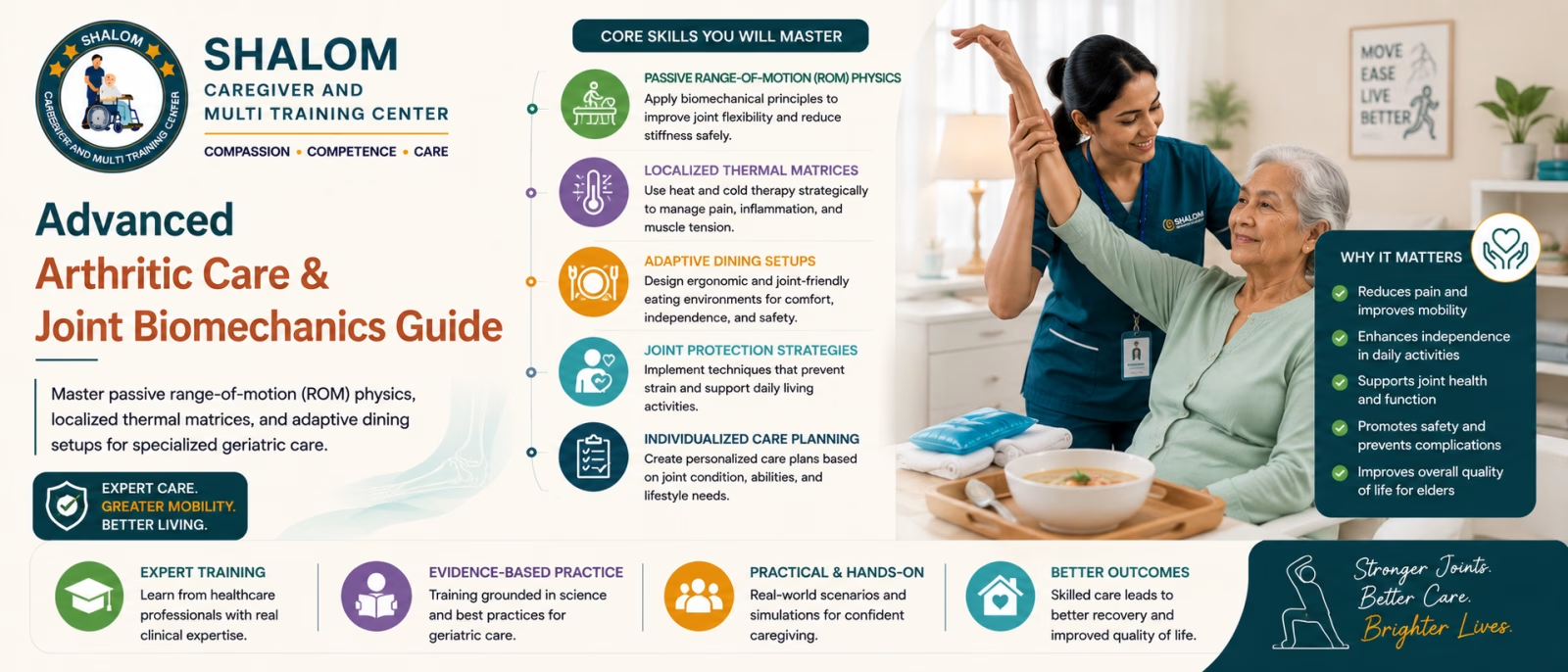
Do not treat severe arthritis like a casual, everyday lifting routine when working inside a private home. When an elderly patient is dealing with advanced osteoarthritis or an intense rheumatoid flare-up, their skeletal junctions become incredibly fragile. A single bad yank, a clumsy pull, or a sudden twist can easily rip tissue, flash intense agony through their body, or cause permanent joint alignment deformities. Protecting a vulnerable individual from these everyday micro-traumas requires deep physical insights built inside a certified caregiver training center in nepal. Enrolling in a structurally sound caregiver course in nepal is the only way to master passive range-of-motion physics and joint-preservation ergonomics, turning you into a highly competent professional who can maintain a senior's mobility without ruining their quality of life.
The absolute worst blunder an untrained home helper makes is trying to force a frozen, stiff joint to move past its resistance limit. If an old person wakes up with locked finger knuckles, frozen shoulders, or rigid knee caps, forcing that limb to stretch open causes instant micro-tearing in the surrounding tendons and joints. Professional assistants look past the superficial stiffness. They treat the arthritic skeletal frame with extreme patience, utilizing localized thermotherapy systems and slow mechanical movements to lubricate the joint capsule naturally before attempting any daily ambulation or self-care routines.
The Clinical Physics of Passive Range-of-Motion (ROM) Execution
Passive range-of-motion routines are not generic, gym-style warm-up stretches. Think of them as targeted mechanical interventions designed specifically to keep fluid sliding around inside non-responsive or locked joint pockets. This active movement prevents the bones from fusing together completely. You must execute these daily movements with precise physical positioning:
First, implement the double-joint cupping rule. Never grab a patient's hand and just yank their arm up into the air. That puts the entire weight of the limb directly onto a fragile, arthritic shoulder socket. Instead, cradle the limb completely by placing one hand firmly under their elbow joint and cupping their wrist joint with your other hand. This supports the long bones completely, isolating the movement safely so the shoulder joint does not take an uncalculated twisting force.
Second, learn to read the micro-resistance wall. Drop the speed entirely when moving a bad hip or bending a rigid knee. Move the leg or arm with total smoothness. The exact fraction of a second you feel the underlying muscle tighten up, or notice the patient’s eyelids flicker or wince, stop right there. Hold that position completely still for fifteen seconds. Do not push even half an inch further. That is their absolute natural boundary for the morning, and crossing it will cause painful swelling for days.
Third, maintain symmetrical extension patterns. Work from the torso out. Start at the shoulder socket, slide down to the elbow, handle the wrist pivot, and manipulate the tiny finger joints at the very end. Loop each circular mobilization exactly five times on one side before moving over to the opposite side of the body. Keeping the repetition count precise ensures their alignment and muscle flexibility stay completely balanced.
Thermotherapy Matrices: Balancing Heat and Cold for Inflammation
Grabbing a random hot water bottle and dumping it onto a bright red, swollen joint is a massive mistake that drives inflammation through the roof. Care workers must understand the biological differences between basic cold stiffness and an active inflammatory crisis before touching the patient with temperature treatments.
If a resident wakes up with a deep, dull morning ache but the skin color over the joint looks totally normal, use heat. Lay a warm, damp towel compress directly around the stiff area for exactly twenty minutes. The moisture dilates local blood vessels, driving oxygen and fresh blood straight into the rigid tissue to soften the joint before morning exercises. However, if the knee or elbow looks angry, purple-red, puffs up, and feels burning hot, heat will destroy the remaining cartilage. Pivot to cold therapy immediately. Wrap a cold gel ice pack inside a thick protective cloth and rest it over the swelling for exactly fifteen minutes. This constricts the blood vessels, deadens the nerve endings, and drops the painful swelling safely.
Adaptive Tool Architecture: Rebuilding Independent Dining Protocols
When advanced arthritis destroys the fine-motor dexterity in an older person's fingers, holding a standard metal spoon becomes a painful struggle. When a senior repeatedly drops their cutlery or spills food, taking the spoon away and feeding them by hand is a massive blow to their mental well-being. It completely shatters their sense of adult independence.
Fix the kitchen setup instead of taking away their control. Swap out regular skinny knives and forks for utensils wrapped in wide, built-up foam grips that do not require tight finger squeezing. Introduce angled spoons and forks that let the patient move food to their mouth without needing to twist a stiff wrist joint. Use heavy, high-rimmed bowls secured to the tabletop with non-slip silicone suction mats so the dish cannot slide away. These simple mechanical tweaks let the senior feed themselves with absolute dignity, preserving their fine-motor neural pathways through daily natural use.
Why Global Healthcare Registries Audit Orthopedic Ergonomics
If you plan to leverage your technical care credentials to migrate into high-paying home care or rehabilitative tracks across the UK, Australia, or Japan, your knowledge of orthopedic ergonomics will be heavily scrutinized. Modern healthcare systems place immense value on workers who understand structural joint preservation because patient falls and joint-related complications drive up hospital liability costs.
During technical evaluations or practical demonstration exams, proctors watch your specific body positioning closely while you support an arthritic patient. They check if you support long bones properly, evaluate your temperature selections for swollen joints, and check your choice of assistive tools. Demonstrating effortless mastery over these advanced arthritic care protocols proves to international examiners that you can manage complex physical limits safely, putting your application straight on the fast track for premium placements.
Building Elite Orthopedic Mobility Skills in Kathmandu
You cannot develop the delicate physical touch needed for passive range-of-motion care by reading notes off a whiteboard or memorizing flashcards. You have to physically practice the joint-cupping grips, manage real thermal packs, and evaluate actual adaptive dining setups inside a live simulated environment rather than relying on basic academies that lack clinical equipment.
That strict commitment to heavy practical run-time is exactly why choosing a recognized academy remains the safest step for your professional development. Situated right at Adwait Marg, Purano Bus Park Road, Kathmandu, our modern facility completely discards outdated lecture methods. We focus our resources on high-fidelity simulation labs where students log their practical clock-hours under the direct watch of registered nursing faculty.
Don't worry about slow manual verification paperwork stalling your immigration background checks either. Every single diploma we print features an advanced, secure QR code for instant worldwide digital verification. This allows foreign embassy personnel, international health ministries, and overseas care registries to scan your certificate from any smartphone and view your verified transcripts and practical lab hours instantly. By learning how to manage complex physical limitations cleanly inside a high-compliance facility, you keep your global healthcare career path safe, fast, and completely secure.
Next Steps for Your Professional Career:
- To compare our specialized training paths and discover flexible morning learning cohorts, explore our comprehensive Main Courses Hub.
- Discover the detailed operational curriculum taught in our specialized Practical Based Caregiver Course landing page.
More
Related posts
Training
Oxygen Therapy Management: Non-Invasive Vent Supportive Routines and Flow Rate Controls for Home Caregivers
Read more →
Educational